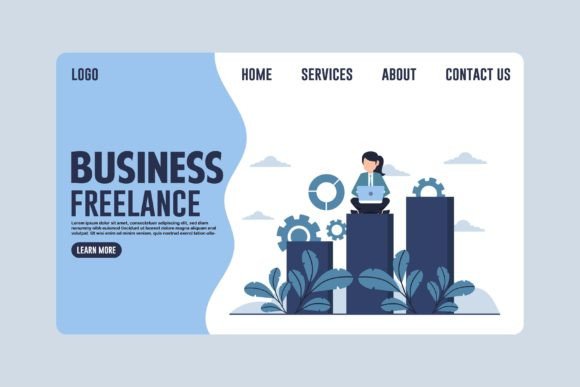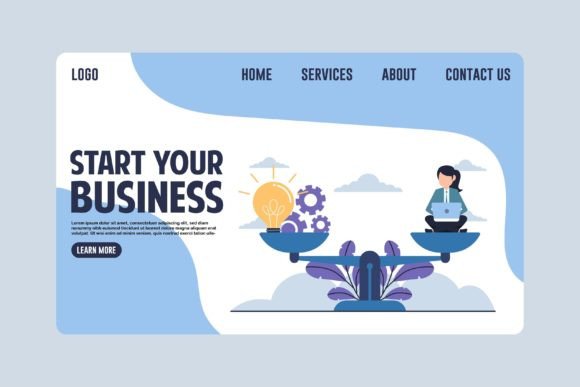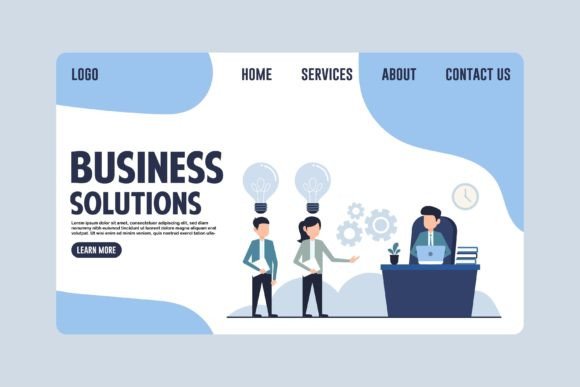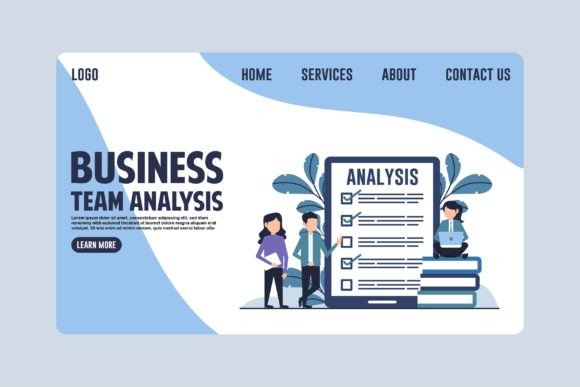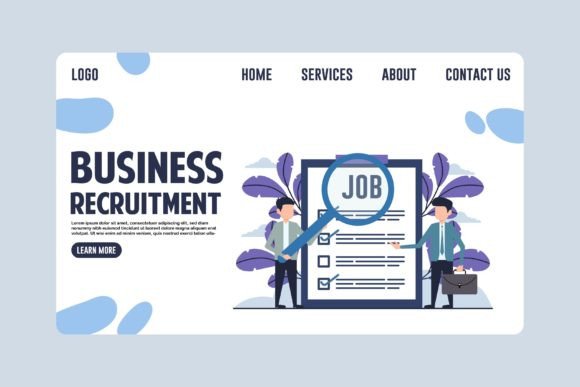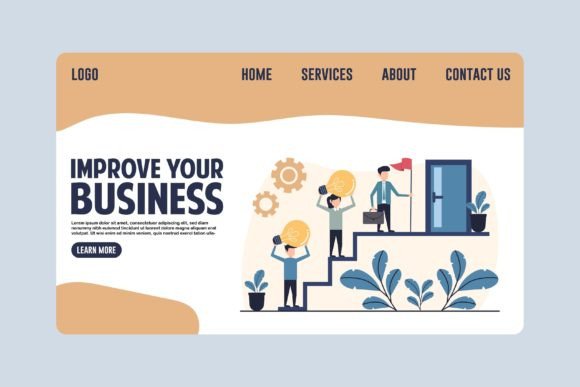
Professional Business Landing Page Design: The Power of 100% Vector Graphics
In the rapidly evolving landscape of digital marketing, the first interaction a potential client has with a brand often occurs on a landing page. This digital storefront must not only convey a message clearly but also load quickly and look impeccable across every device imaginable. At the heart of this visual communication lies the choice of asset format. While raster images have dominated for decades, there is a distinct shift toward Professional Busines Landing Page Design that relies entirely on vector graphics. Understanding why 100% vector assets are superior for modern web projects requires an exploration of scalability, editing flexibility, and the practical workflows they enable for designers and business owners alike.
The Technical Advantage of Scalable Vector Graphics
The fundamental difference between a standard image file and a vector graphic lies in how the computer interprets the data. Raster images, such as JPEGs or PNGs, are composed of a fixed grid of pixels. When you enlarge a pixel-based image beyond its original resolution, the software must guess what new pixels should look like, resulting in blurriness or jagged edges known as aliasing. In contrast, vector graphics are defined by mathematical equations describing points, lines, curves, and shapes. This mathematical foundation means that a vector illustration can be scaled from the size of a mobile app icon to a massive billboard without losing a single ounce of clarity.
For a Professional Busines Landing Page Design, this characteristic is indispensable. Modern users access websites through a myriad of devices, ranging from small smartphones with high-density Retina displays to large desktop monitors and 4K screens. A design built on vector principles ensures that hero images, icons, and infographics remain crisp and sharp regardless of the screen resolution. This consistency in visual quality directly impacts user perception; a blurry logo or pixelated banner can subconsciously signal unprofessionalism, whereas a perfectly rendered vector graphic reinforces trust and authority.
Editing Flexibility Without Quality Loss
Beyond mere scaling, the true power of vector files lies in their editability. When a design template states that all elements are 100% vector, it implies that every component is a distinct, manipulatable object within the file structure. Unlike a flattened raster image where changing a color might require complex masking or starting over, vector files allow designers to transform, scale up or down, add or remove elements, and recolor specific parts instantly. This capability is crucial for businesses that need to adapt their branding quickly or test different variations of a landing page for A/B testing purposes.
Consider a scenario where a company decides to change its primary brand color from blue to green. With a raster-based design, the designer would likely need to recreate the entire graphic or use time-consuming selection tools that often leave behind artifacts. With a vector source file, the color change is a matter of seconds. Furthermore, if a specific element needs to be removed to simplify the composition for a mobile view, it can be deleted without affecting the integrity of the surrounding artwork. This level of control allows for rapid iteration, which is essential in agile marketing environments where speed to market is a competitive advantage.
Workflow Efficiency for Designers and Creators
The adoption of vector-centric workflows significantly alters the experience for professionals working in graphic design. Having access to 100 vector source files in EPS formats provides a robust foundation for any creative project. EPS (Encapsulated PostScript) is a versatile format widely supported by industry-standard vector graphics software. It preserves layers, paths, and text editability, allowing designers to open the file and immediately begin customizing it to fit their specific project requirements.
This workflow efficiency extends beyond simple customization. Designers can easily integrate these vector assets into various design ecosystems. Whether the goal is to create a cohesive set of web graphics, design a responsive mobile web interface, or craft a detailed infographic, the same core assets can be repurposed. For instance, a complex illustration used as a hero image on a desktop landing page can be deconstructed. Individual elements can be extracted and resized to serve as icons for a mobile navigation menu or as standalone graphics for social media banners. This modularity maximizes the value of the initial design investment, reducing the time spent creating new assets from scratch for every new campaign.
Integration with Modern Web Technologies
While the source files may come in EPS format for professional editing, the final output for the web often utilizes SVG (Scalable Vector Graphics). This transition is seamless because both formats share the same underlying vector logic. Using SVG for web implementation offers additional benefits beyond visual fidelity. Vector files are typically smaller in file size compared to high-resolution raster images, leading to faster page load times. In an era where site speed is a critical ranking factor for search engines and a key determinant of user retention, optimizing image weight without sacrificing quality is a strategic necessity.
Furthermore, vector graphics can be styled using CSS, allowing for dynamic interactions. Buttons can change color on hover, illustrations can animate smoothly, and layouts can adjust fluidly based on the viewport. This interactivity enhances the user experience, making the landing page feel more engaging and alive. A Professional Busines Landing Page Design that leverages these capabilities stands out against competitors relying on static, heavy image files.
Practical Applications Across Digital Platforms
The versatility of 100% vector designs makes them suitable for a wide array of applications beyond just a single webpage. For business owners and marketers, understanding the breadth of these use cases helps in planning comprehensive digital strategies. One primary application is the creation of high-impact hero images. These large, attention-grabbing visuals at the top of a landing page set the tone for the entire site. Because they are vector-based, they maintain their impact whether viewed on a laptop in an office or a tablet on a commute.
Banners and promotional graphics represent another significant area of application. Online advertising campaigns often require assets in multiple sizes to fit different ad slots. With vector source files, resizing these banners for Google Ads, social media feeds, or sidebar placements becomes trivial. There is no need to worry about pixelation when stretching a banner to fit a wide leaderboard or shrinking it for a mobile feed. The mathematical precision of vectors ensures that the call-to-action buttons and text remain legible and inviting at any dimension.
Infographics and Data Visualization
Complex information needs to be communicated simply, and infographics are the ideal medium for this task. However, creating effective infographics requires precise alignment and clean lines, which are hallmarks of vector design. When educational content, research findings, or business metrics need to be presented visually, vector graphics provide the necessary clarity. Elements such as charts, graphs, and flowcharts can be easily modified as data changes. If a statistic updates, the corresponding bar in a chart can be adjusted without redrawing the entire graphic.
Moreover, for educators and researchers, the ability to print these materials at high resolutions is a bonus. While the primary focus here is digital, the vector nature of the files means they can be sent to a printer for brochures, posters, or conference handouts without any loss of quality. This dual-purpose capability—excellent for both screen and print—makes vector assets a cost-effective solution for organizations looking to maintain brand consistency across all channels.
Strategic Considerations for Implementation
While the advantages of vector graphics are clear, implementing them effectively requires some strategic thought. First, it is important to ensure that the design team possesses the necessary skills to work with vector software. Tools like Adobe Illustrator, CorelDRAW, or open-source alternatives like Inkscape are required to manipulate EPS files. Investing in training or hiring talent proficient in these tools is a prerequisite for fully leveraging the potential of a 100% vector design template.
Second, while vector files are generally lightweight, overly complex illustrations with thousands of anchor points can still bloat the final SVG code and slow down rendering. It is best practice to optimize the vector files before exporting them for the web. Simplifying paths and removing unnecessary metadata can further enhance performance. Additionally, while the template includes high-resolution JPG files for immediate preview or use in contexts where vectors are not supported, relying solely on rasters defeats the purpose of the scalable design philosophy. The JPGs should be viewed as backups or previews, with the vector versions serving as the primary production assets.
Long-Term Brand Consistency
Finally, adopting a vector-first approach contributes to long-term brand consistency. As a business grows, its visual identity may evolve slightly, but the core elements should remain recognizable. Vector files act as a master library of these elements. By maintaining a repository of editable vector assets, a company ensures that every piece of content produced—from the next landing page to a holiday email campaign—adheres to the established visual standards. This consistency builds brand recognition and trust over time.
In conclusion, the shift toward Professional Busines Landing Page Design utilizing 100% vector graphics represents a mature understanding of digital requirements. It addresses the technical demands of multi-device compatibility, the creative needs for flexibility and customization, and the strategic goals of performance and brand consistency. For professionals, creators, and business owners, investing in high-quality vector resources is not merely a design choice but a foundational step toward building resilient, effective, and future-proof digital experiences. The ability to transform, scale, and recolor without compromising quality empowers teams to respond swiftly to market changes while maintaining the highest standards of visual excellence.